.svg)

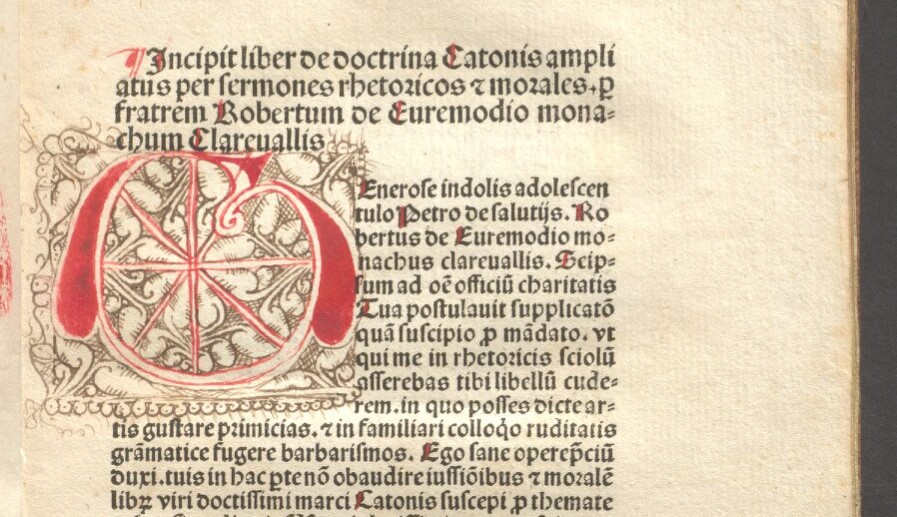
Cato moralissimus cum elegantissimo commento, Basel: Nikolaus Kessler, 1488 (digitized by Bayerische Staatsbibliothek) (CC BY-NC-SA 4.0)
Robertus de Euremodio
Robertus of Euremodio (Robert of Evremodio) was a monk who wrote a commentary on the Disticha Catonis in the second half of the fourteenth century.
Biography
A conventual monk at the Abbey of Cluny, Robert was from Envermeu, at the southern edge of the Dutch/Flemish zone, now a commune in the modern-day Département Seine-Maritime in Normandy, France (Bandzuhl 279) [4]. The few details known about Robertus’s life come from his dedicatory letter to Pierre de Saluces (Petrus de Saluciis).
Dating Robert’s work can be approximated by inspecting the biographical details of Pierre. His father was the Marquis of Saluces, Frederico II (ca. 1330-1396) and his mother was Beatrice of Geneva. [1] In 1393, Pierre studied law at the University of Orleans, was canon of Amiens from 1382-1389, and became bishop of Mende in 1409. His date of death is September 1412.[2] In his letter to Pierre, Robert describes him as adulescentulus [“adolescentulo Petro”], suggesting an age appropriate for reading an elevated commentary on the Disticha Catonis. Given his law studies in 1393, it would seem Robert wrote the letter, and commentary, not later than 1375.[3]
Commentary
Robert’s commentary is entitled Liber de doctrina Cathonis ampliatus per sermones rethoricos et morales. The style and vocabulary, which is reminiscent of Alan of Lille’s Anticlaudianus and De planctu naturae, are highly rhetorical and unsuitable for students at the primary school level. The commentary must have been written for students who were ready to begin reading more challenging Latin authors.[3] Meanwhile, the content of his commentary is characterized as elaborate variation of the distichs themselves.[4] His commentary works to harmonize Christian doctrine and pagan wisdom, and he does this primarily by using phrases of scripture to explain the pagan text. But the priority of the commentary seems to be the rhetorical language in which the distichs are reworded and amplified.
Manuscripts and Prints
The relationship between the manuscripts and incunables is uncertain. Previously, scholars have suggested eight or nine extant manuscripts, though presently the number is known to be greater.[1] The text survives in great numbers in its incunable form, and two incunable editions have been discerned (from 1470 and 1485).[4] A sizable work in printed form, it is 9,000 words and ninety pages in length. The format of the printed editions, which included materials beyond Robert’s commentary, made the work more useful for a classroom. Each relevant distich appears in a large font, along with smaller glosses, Robert’s commentary, and the correlating verse from the Cato Novus, an eleventh-century version of the Distichs in leonine hexameter. The printer also included the sententia breves and the epistula.[3]
Reception
Robert’s commentary appears in sixteen incunable editions in Germany, both in a collection of commentaries and in commentated editions of the Distichs. His commentary is found in only one out of 44 editions in the French-speaking region but seems to be the common commentary in the Low Countries. It was printed only once in Italy before 1500, and shortly after 1500 was replaced by the Erasmus commentary.
It seems that Erasmus of Rotterdam found fault with Robert’s commentary. In the dedicatory letter of his own commentary on the Distichs, he critiques two unnamed authors in his letter, one “rhetoricizing in a most tasteless fashion” (insulsissime rhetoricatur) and the other “philosophizing in the most inappropriate fashion” (ineptissime philosophatur).[5][3] The respective targets of Erasmus’ criticism are Robert and Philippus de Bergamo, fourteenth-century Benedictine Prior of Santa Maria in Vango in Padua and author of Speculum regiminis.[6]